Following active fire suppression in communities like Silver Lake, Encino, and Boyle Heights, standing framing timbers retain burnt wood fibers and micro-porous carbon layers that off-gas volatile organic compounds.…
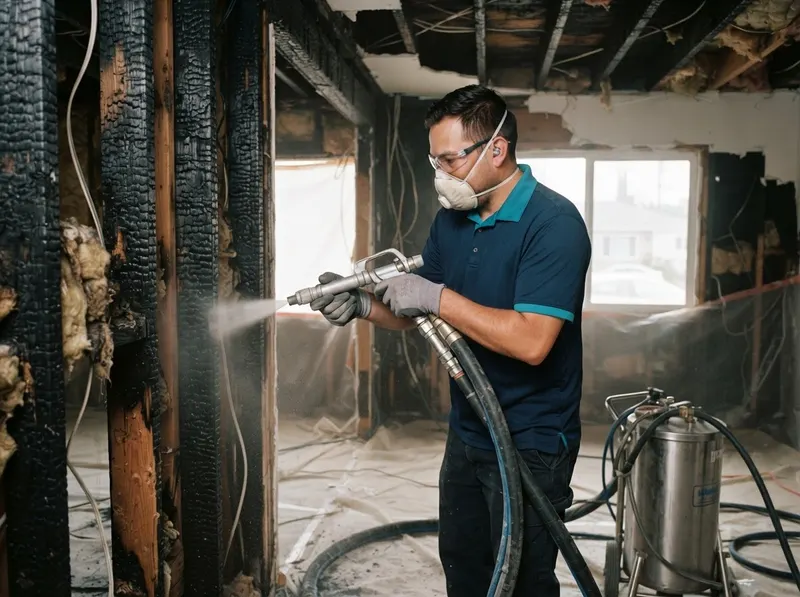
Following active fire suppression in communities like Silver Lake, Encino, and Boyle Heights, standing framing timbers retain burnt wood fibers and micro-porous carbon layers that off-gas volatile organic compounds. Charred framing media blasting stabilizes the structural core of the building by abrading the charred exterior wood layers down to sound, uncompromised amber grain. Media blasting eliminates the need for full structural demolition of load-bearing walls, preserving the original framing lumber when the structural engineer confirms cross-sectional integrity. The mechanical action of compressed media physically scours out soot particulates trapped inside deep wood checks and splits, which standard hand-sanding or chemical encapsulants fail to penetrate.
Technicians deploy specialized media depending on the substrate depth and local environmental requirements. Dry ice blasting sublimates instantly on contact into harmless carbon dioxide gas, leaving zero secondary grit aggregate to clean from floor cavities, wall tracks, or crawlspaces. In properties with heavy alligator-pattern charring across roof trusses, frequently seen in hillside properties in Studio City, Los Feliz, or Pacific Palisades, recycled crushed glass or soda media provides the cutting friction needed to strip calcified carbon crusts. The deliberate trade-off involves secondary residue cleanup: dry ice leaves only displaced soot particles to HEPA vacuum, while mineral abrasive blasting requires comprehensive vacuum recovery of spent media aggregate, though it cuts through severe char up to 40% faster on deeply burnt timbers.
Execution follows a four-step clinical remediation protocol to prevent cross-contamination into unaffected living zones. Step 1: Technicians erect 6-mil poly-sheeting containment chambers equipped with continuous negative-pressure HEPA air scrubbers venting directly to exterior spaces. Step 2: High-pressure blast systems operating at 80 to 140 PSI systematically sweep every exposed timber face, corner joint, and nail plate until bare wood appears. Step 3: Complete secondary extraction occurs via three-stage HEPA vacuums capturing detached particulate down to 0.3 microns. Step 4: The exposed wood receives an application of clear, antimicrobial, vapor-barrier encapsulant that permanently locks remaining cellular pores. This protocol guarantees that thermal odors do not migrate through drywall assemblies or HVAC plenums once the building envelope is sealed.
Every job gets a firm, written price after a free on-site visit.
Tell us about your charred framing media blasting job in los angeles and we'll send a clear, written quote, usually the same day.
 Prime Fire Damage Restoration