Municipal firefighting efforts routinely pump between 1,500 and 3,000 gallons of suppression water into a residential blaze, leaving behind severe compounding structural saturation alongside smoke and soot residues.…
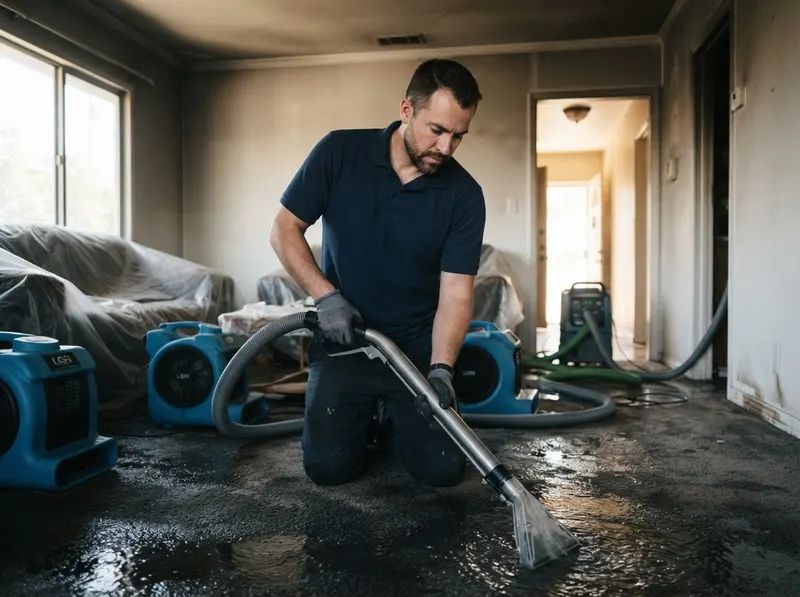
Municipal firefighting efforts routinely pump between 1,500 and 3,000 gallons of suppression water into a residential blaze, leaving behind severe compounding structural saturation alongside smoke and soot residues. When water accumulates inside multi-story properties, from hillside mid-century moderns in Silver Lake and Los Feliz to sprawling single-family estates in Encino and Brentwood, it travels down wall cavities, saturates drywall layers, and pools under subflooring. The combination of standing water, elevated indoor temperatures, and organic soot creates a prime breeding ground for microbial amplification within 24 to 48 hours. Prime Fire Damage Restoration executes controlled mitigation by first deploying high-volume truck-mounted extraction units and commercial submersible pumps to evacuate bulk standing water before the liquid compromises load-bearing foundations or basement footings.
Structural drying requires calibrated scientific evaporation rather than simple ambient airflow. In coastal environments like Pacific Palisades, exterior relative humidity routinely exceeds 75 percent, preventing standard ambient drying; conversely, dense urban construction across Koreatown and Boyle Heights demands precise air scrubbing to capture toxic particulates aerosolized by airflow. Crews map total moisture depth using non-penetrating thermal imaging cameras and penetrating pin probes measured against dry standards established according to IICRC S500 guidelines. Commercial LGR (low-grain refrigerant) dehumidifiers and desiccant units are positioned to draw water vapor directly out of dense framing lumber, floor joists, and concrete slabs, while HEPA air filtration captures airborne soot dislodged during the structural evaporation process.
Selecting emergency structural drying immediately following extinguishment preserves rebuildable framing, whereas postponing extraction forces full demolition of joists, studs, and subfloors down to bare ground. A targeted drying setup running commercial air movers and desiccant equipment requires continuous 240-volt or dedicated 15-to-20 amp circuits and temporarily increases ambient interior heat, but it preserves structural assemblies that would otherwise require costly permits from the Los Angeles Department of Building and Safety (LADBS). For properties located in Studio City or Northridge, rapid water evacuation prevents moisture from wicking upward into upper-story drywall ceilings and eliminates lingering suppression-water odors embedded within plaster. Step one executes bulk water extraction within hours of site clearance; step two establishes a drying chamber with industrial dehumidification; step three monitors dry standards daily with calibrated moisture meters until moisture content drops below 12 percent across structural lumber.
Every job gets a firm, written price after a free on-site visit.
Tell us about your firefighting water extraction and structural drying job in los angeles and we'll send a clear, written quote, usually the same day.
 Prime Fire Damage Restoration